- Ask
- Counsel
October 13, 2026
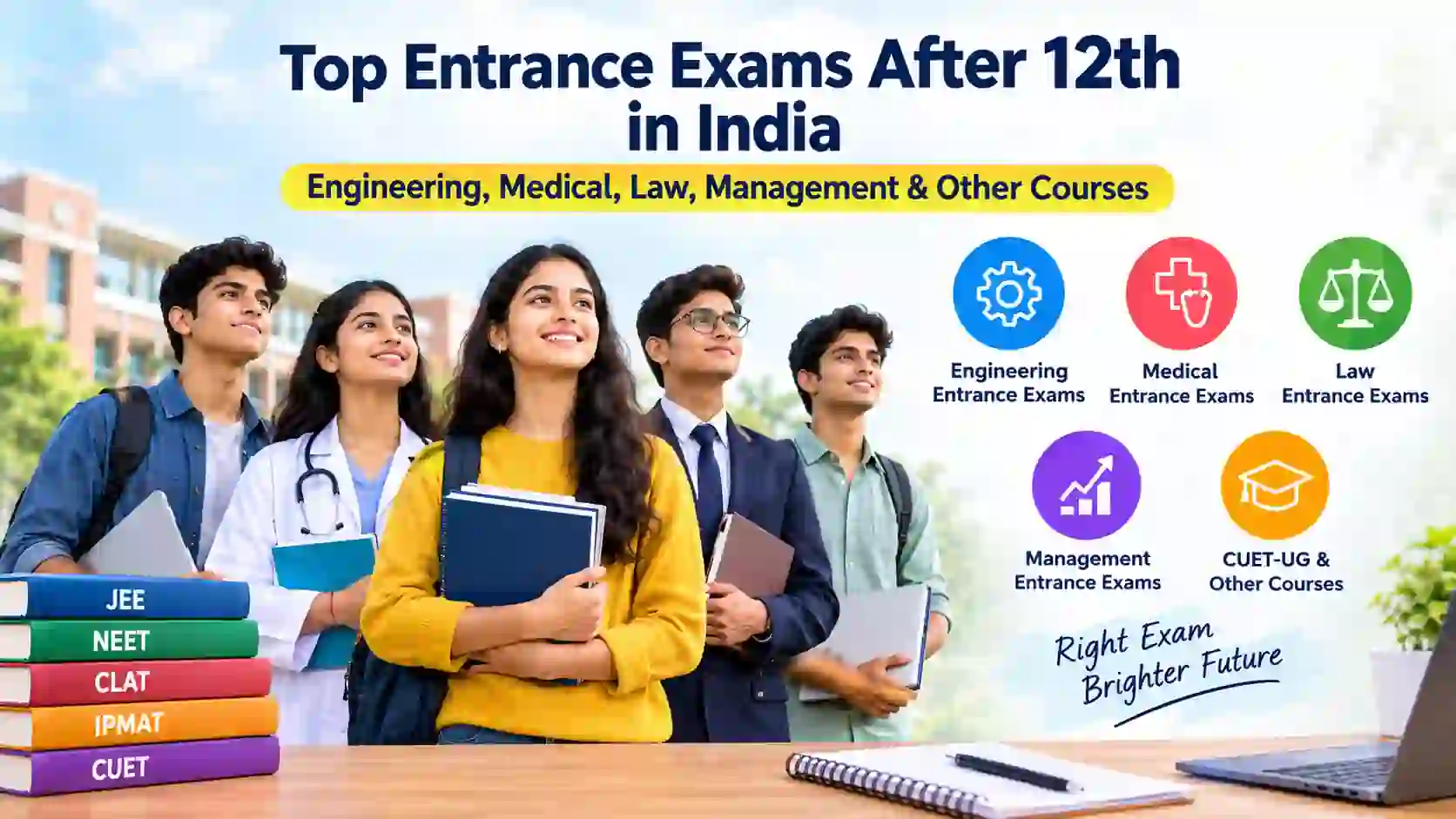
Completing your Class 12 board examinations is one of the most exciting turning points in your student life. It marks the end of school uniforms and daily attendance registers, and opens the door to independent college life and future career choices. However, for most students and parents across the country, this transition brings big questions: Which college should I choose? Which career line fits my skills? Which tests should I apply for? In modern education, gaining a seat in a premier university or government college almost always requires qualifying through competitive entrance exams after 12th.
Over the last few years, the system of college admissions in India has changed drastically. High percentage scores in board exams alone are no longer enough to secure seats in prestigious degree programs. Today, nationwide and state-level entrance exams in India serve as the common gateway to ensure fair, merit-based selection. Whether your heart lies in building machines, diagnosing patients, fighting courtroom battles, managing corporate enterprises, or designing creative products, sitting for the right entrance test is your necessary first step.
Understanding the massive variety of tests, their changing patterns, and their eligibility rules can feel confusing. That is why having dedicated AdmissionWala Entrance Exam Guidance makes all the difference. In this comprehensive guide, we walk you through the top entrance exams after 12th, covering Engineering, Medical, Law, Management, and popular multidisciplinary streams, so you can plan your next academic steps with complete clarity.
In earlier decades, many central and state universities admitted students solely on Class 12 cut-off marks. This created high pressure on board results and caused unfair disparities due to differing evaluation standards across state and central boards.
Today, standardized entrance exams for college admission level the playing field:
Equal Opportunity for Every Student: A single common test evaluates students on a uniform benchmark, regardless of whether they studied under CBSE, ICSE, or a State Board.
Focus on Real Understanding: Unlike rote memory tests, entrance exams evaluate problem-solving abilities, logical aptitude, and conceptual depth.
Transparent Merit Rankings: Your national or state rank determines your admission counseling rounds, eliminating arbitrary cut-offs and back-door uncertainties.
Access to Top-Ranked Institutions: Admission into premier institutes like IITs, NITs, AIIMS, NLUs, and IIMs is possible exclusively through designated national tests.
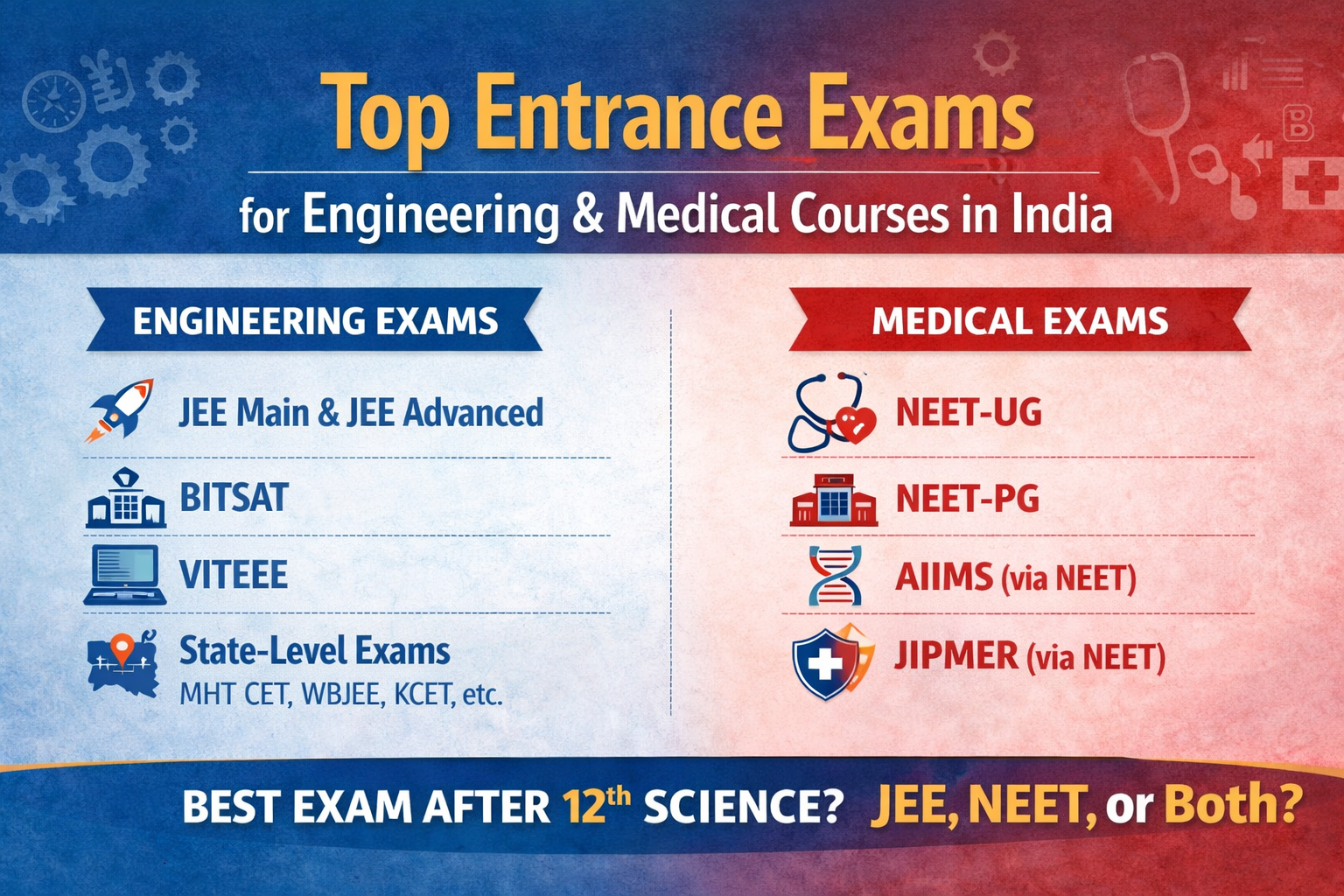
For students coming from the science stream with Physics, Chemistry, and Mathematics (PCM), engineering remains a popular and dynamic career choice. From Computer Science and Artificial Intelligence to Aerospace and Civil Engineering, the path begins with national and institute-specific engineering entrance exams.
JEE Main (Joint Entrance Examination Main): Conducted by the National Testing Agency (NTA), JEE Main is the largest engineering test in the country. It serves two purposes: it offers admission to top National Institutes of Technology (NITs), Indian Institutes of Information Technology (IIITs), and Government Funded Technical Institutes (GFTIs), while also serving as the preliminary qualifying filter for JEE Advanced.
JEE Advanced: Only the top 2.5 lakh qualifiers of JEE Main are eligible to appear for JEE Advanced, which opens the doors to the world-renowned Indian Institutes of Technology (IITs).
BITSAT: The Birla Institute of Technology and Science Admission Test offers access to prestigious BITS campuses in Pilani, Goa, and Hyderabad. It is famous for testing speed and accuracy in PCM along with English proficiency and logical reasoning.
State Engineering Tests (MHT CET, WBJEE, KCET, COMEDK): For students seeking seats in top state government and renowned private engineering colleges in Maharashtra, West Bengal, and Karnataka, these state-level tests offer high return on investment.
When exploring entrance exams after 12th science, technical aspirants should always prepare for JEE Main alongside at least two reliable state or private university exams to secure strong backup options.
For biology students (PCB), working in healthcare is a noble calling. The landscape of medical entrance exams in India is clear and centralized.
NEET-UG (National Eligibility cum Entrance Test): NEET-UG is the single unified entrance examination across the entire country for admission into undergraduate medical courses. Whether you aim for MBBS, BDS (Dental), BAMS (Ayurveda), BHMS (Homeopathy), BUMS (Unani), or BSMS (Siddha), qualifying in NEET is mandatory. It grants access to all government medical colleges, premier institutions like AIIMS and JIPMER, as well as private deemed medical universities across India.
Apart from core medicine, healthcare offers vibrant alternative career pathways:
NEET for BSc Nursing: Several central institutions and military nursing colleges now utilize NEET-UG scores for BSc Nursing admissions.
ICAR AIEEA (CUET): For students interested in Agriculture, Horticulture, Forestry, and Food Science, entrance through ICAR tests opens up stable careers in agricultural science and biotechnology.
State Paramedical & Pharmacy Tests: Many states conduct independent entrance tests for B.Pharm, Physiotherapy (BPT), and Medical Lab Technology (BMLT).
Through personalized AdmissionWala College Admission Guidance, students discover how to match their NEET percentile with the right state quota or private deemed medical seats without falling victim to misleading admission promises.
Law is no longer restricted to traditional courtroom arguments; it has evolved into a lucrative career covering corporate mergers, intellectual property rights, international cyber laws, and public policy. Modern 5-year integrated law programs (BA LLB, BBA LLB, B.Com LLB) admit students via highly competitive law entrance exams.
CLAT (Common Law Admission Test): CLAT is the premier national test that opens admissions to 24 prestigious National Law Universities (NLUs) across India. It evaluates comprehension, current affairs, legal reasoning, logical deduction, and quantitative techniques.
AILET (All India Law Entrance Test): Conducted separately by the National Law University, Delhi (NLU Delhi), AILET is known for its rigorous testing format and limited seats.
SLAT & LSAT India: Symbiosis Law Admission Test (SLAT) provides access to top Symbiosis law campuses, while LSAT India serves as a gateway to leading private law universities such as Jindal Global Law School.
State Law CETs (e.g., MH CET Law): Excellent state law universities, such as Government Law College (GLC) Mumbai and ILS Pune, accept scores from designated state CET examinations.
Traditionally, management degrees like the MBA were pursued only after graduation. However, India's leading business schools now offer direct 5-year Integrated Programmes in Management (IPM), combining a BBA and MBA. For students researching entrance exams after 12th commerce and humanities, management entrance exams offer high career acceleration.
IPMAT (IIM Indore & IIM Rohtak): The Integrated Program in Management Aptitude Test offers students the opportunity to enter top Indian Institutes of Management (IIMs) straight out of school. IIM Indore, IIM Rohtak, IIM Ranchi, and IIM Jammu offer 5-year dual-degree programs based on IPMAT scores.
JIPMAT (Joint Integrated Programme in Management Aptitude Test): Conducted by NTA for admissions into the 5-year integrated programs at IIM Bodh Gaya and IIM Jammu.
NPAT & SET: NMIMS Programs After Twelfth (NPAT) and the Symbiosis Entrance Test (SET) provide direct admission into leading undergraduate BBA and finance degree programs in Mumbai, Pune, and Bengaluru.
No conversation regarding modern entrance exams in India is complete without mentioning the Common University Entrance Test (CUET-UG).
Introduced by the Ministry of Education and administered by the NTA, CUET-UG has unified undergraduate admissions across over 250 universities, including premier central universities like:
University of Delhi (DU)
Banaras Hindu University (BHU)
Jamia Millia Islamia
Jawaharlal Nehru University (JNU)
Allahabad University
Whether you want to pursue B.Com (Hons), BA Economics, BSc Physics, Journalism, or Psychology, CUET-UG eliminates unrealistic 99% board cut-offs and assesses students through domain-specific and general aptitude tests.
With dozens of exam application forms opening between November and March every year, filling out every single form is expensive and stressful. Follow this 4-step framework to finalize your exam list:
Identify Your Genuine Core Strengths: Do not pick engineering or medicine simply because your peers are doing so. Assess whether your strength lies in numerical calculations, conceptual biology, creative writing, or analytical arguments.
Select 1 Primary and 2 Backup Exams: Focus 80% of your energy on your primary goal (for example, JEE Main or NEET), but always register for 2 backup exams that follow overlapping syllabus structures (such as CUET or State CETs).
Verify Age and Eligibility Rules: Check minimum percentage criteria (e.g., 75% in boards for JEE or 50% PCB for NEET) and subject prerequisites before paying registration fees.
Seek Professional Counseling: Reliable guidance protects you from wrong exam choices and missed application deadlines. With AdmissionWala Exam & College Guidance, students receive curated exam timelines, cutoff tracking, and step-by-step assistance through application forms and choice filling.
Your Class 12 journey is a stepping stone to building a rewarding and independent career. While the sheer number of tests and application forms can seem intimidating, taking a planned approach to the top entrance exams after 12th turns confusion into confidence.
Understand your core interests, prepare systematically, take regular mock tests, and maintain backup options across premier entrance exams in India.
Remember, you do not have to navigate this critical decision alone. Connect with AdmissionWala today for personalized AdmissionWala Exam & College Guidance. Our experienced mentors are here to guide you from your exam application straight to your dream college campus!
For science students, the most important exams are JEE Main and JEE Advanced (for Engineering and Architecture), NEET-UG (for Medicine and Allied Healthcare), BITSAT, and CUET-UG (for central university science degrees).
Yes, absolutely. Commerce students can apply for CLAT and AILET for 5-year integrated law, IPMAT and JIPMAT for IIM integrated management courses, and CUET-UG for B.Com (Hons) and BMS programs across top central universities.
CUET is mandatory for all central universities (like Delhi University and BHU) and is also accepted by dozens of state, private, and deemed universities. However, professional technical courses like MBBS and B.Tech continue to require NEET and JEE respectively.
Ideally, preparation begins alongside Class 11, as entrance syllabi cover both Class 11 and Class 12 concepts. However, dedicated and disciplined 6 to 8-month preparation focused on Previous Year Questions (PYQs) and mock tests is also effective for qualifying.
AdmissionWala provides end-to-end support through AdmissionWala Entrance Exam Guidance and AdmissionWala College Admission Guidance. Our experts help students select the right exams, track critical registration dates, analyze cutoffs, and navigate state and central counseling processes smoothly.

16 Oct 2026 | 11:36 AM
12 Feb 2026 | 9:46 AM

13 Feb 2026 | 12:16 PM
14 Mar 2026 | 9:29 AM
13 May 2026 | 2:50 PM

2 Jun 2026 | 6:11 AM