
- Ask
- Counsel
June 27, 2026
#AIQ vs State Quota
# NEET 2026
# NEET Counselling
# Medical College Predictor
# NEET College Predictor
# MBBS Admission
# AIQ Counselling
# State Quota Counselling
# Government Medical Colleges
# Medical Admission
# NEET Rank Predictor
# Medical College Prediction
# MCC Counselling
# NEET Admission Guide
# Admission Wala
After clearing NEET 2026, every medical aspirant faces one of the most important decisions of their admission journey—choosing the right counselling process. While preparing for the examination requires months or even years of dedication, securing admission into the best possible medical college depends largely on understanding the counselling system. Many students focus only on their NEET score and NEET rank, but they often overlook the significance of All India Quota (AIQ) and State Quota Counselling. This lack of understanding can result in poor choice filling, missed opportunities, or even losing a seat in a good government medical college.
Every year, thousands of deserving students fail to secure admission to their preferred college, not because of low marks, but because they are unaware of how AIQ Counselling and State Quota Counselling work. Knowing the difference between these two counselling systems is essential for predicting your medical college and creating a smart counselling strategy.
In this detailed guide by Admission Wala, we will explain everything you need to know about AIQ vs State Quota, including eligibility, reservation rules, counselling process, seat distribution, cutoff trends, advantages, disadvantages, and how you can accurately predict your medical college before counselling begins.
The National Eligibility cum Entrance Test (NEET) is the single entrance examination for admission into undergraduate medical courses such as MBBS, BDS, BAMS, BHMS, BUMS, and several allied medical programs across India. Once the examination results are announced, qualified candidates become eligible to participate in counselling for seat allocation.
Medical counselling is not conducted by a single authority. Instead, the admission process is divided into two major counselling systems:
| Counselling Type | Seats Covered | Conducting Authority |
|---|---|---|
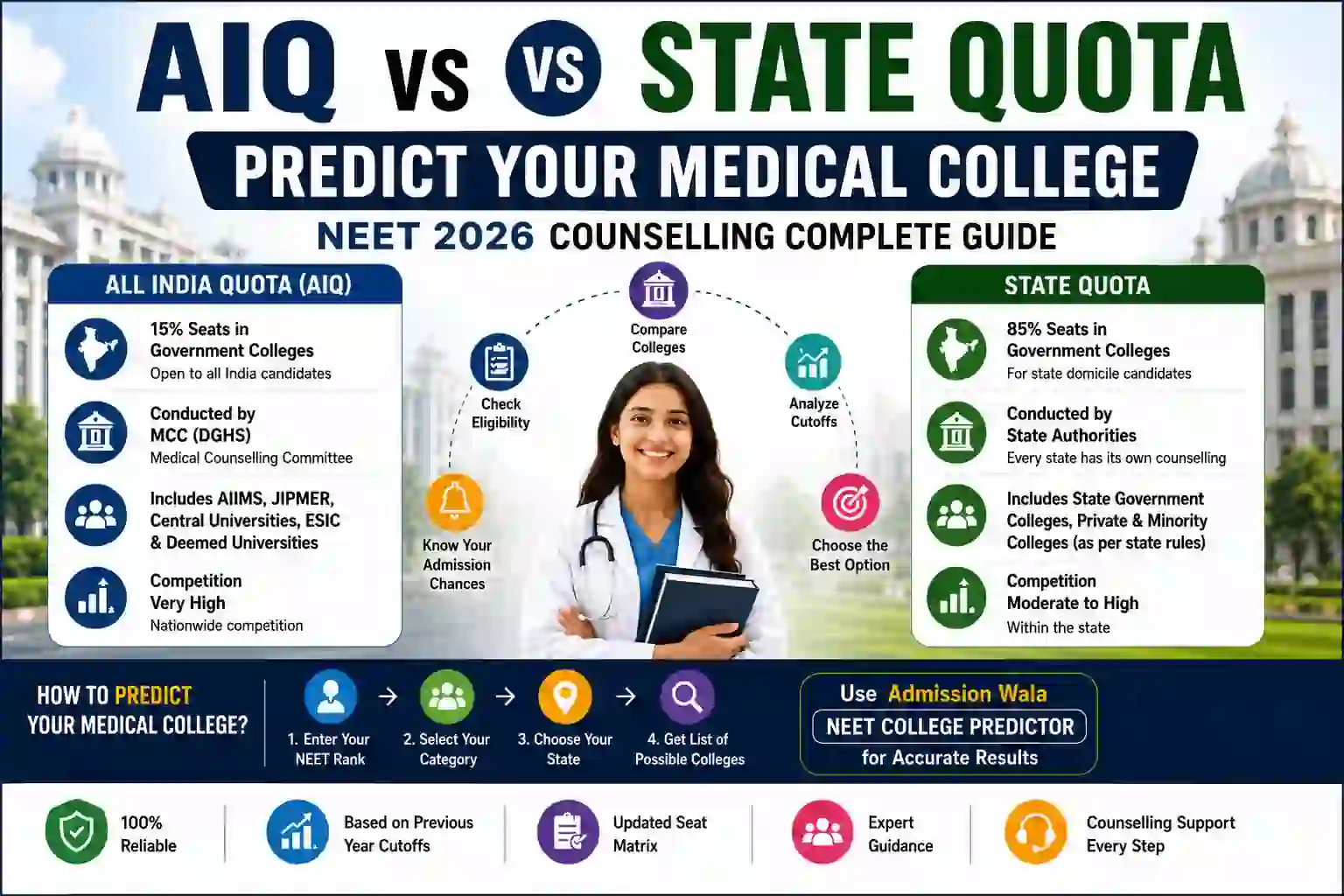
| All India Quota (AIQ) | 15% Government Medical Seats, AIIMS, JIPMER, Central Universities, ESIC, Deemed Universities | Medical Counselling Committee (MCC) |
| State Quota | 85% Government Medical Seats of Individual States | Concerned State Counselling Authorities |
Both counselling systems operate independently, and understanding their differences can dramatically improve your chances of getting admission into a reputed medical college.
All India Quota (AIQ) is a centralized counselling system that allows eligible NEET-qualified students from across India to compete for a specific percentage of government medical seats irrespective of their home state. Instead of restricting admissions to local students, AIQ gives candidates the opportunity to pursue medical education in various states through a common counselling process.
Under the AIQ system, 15% of the total seats in Government Medical Colleges are reserved for candidates from all over India. Apart from these seats, counselling for institutions such as AIIMS, JIPMER, ESIC Medical Colleges, Central Universities, and Deemed Universities is also conducted through the Medical Counselling Committee (MCC).
This means a student from Bihar can secure admission in a government medical college in Karnataka, Rajasthan, Maharashtra, Delhi, or any other participating state if they have a competitive NEET rank and meet the eligibility requirements.
| Feature | Description |
|---|---|
| Seat Percentage | 15% Government Medical Seats |
| Eligibility | Open to candidates from all eligible states |
| Counselling Authority | Medical Counselling Committee (MCC) |
| Institutions Covered | Government Medical Colleges, AIIMS, JIPMER, Central Universities, ESIC and Deemed Universities |
| Competition Level | Very High because students from across India participate |
The biggest advantage of AIQ is that it provides students with access to some of India's finest medical institutions without restricting admissions to state residents.
While AIQ allows students to compete nationally, State Quota Counselling focuses on candidates belonging to a particular state. Under this system, 85% of the government medical seats are reserved primarily for students who satisfy the domicile or eligibility criteria specified by the respective state government.
Every state conducts its own counselling process independently after the declaration of NEET results. Students who have completed their schooling within the state or possess valid domicile certificates usually become eligible for these seats, although eligibility rules vary from state to state.
For example, a student who belongs to Bihar can participate in Bihar State Counselling, while a candidate from Rajasthan can compete for Rajasthan Government Medical Colleges through Rajasthan State Counselling.
| Feature | Description |
|---|---|
| Seat Percentage | 85% Government Medical Seats |
| Eligibility | Domicile or state-specific eligibility |
| Conducted By | Individual State Counselling Authorities |
| Competition Level | Limited to eligible state candidates |
| Reservation Policies | State Reservation Rules Apply |
Since only eligible candidates of a particular state participate, competition is comparatively lower than AIQ in many cases. As a result, several students secure admission into government medical colleges through State Quota even when they cannot obtain a seat through AIQ.
Although both counselling systems allocate medical seats based on NEET Rank, they differ significantly in terms of eligibility, competition level, reservation policies, and admission opportunities. Students who understand these differences can create a much stronger counselling strategy.
| Parameter | All India Quota (AIQ) | State Quota |
|---|---|---|
| Seat Share | 15% | 85% |
| Eligibility | Students across India | State Eligible Candidates |
| Competition | Very High | Moderate to High |
| Counselling Authority | MCC | State Authorities |
| Domicile Required | No | Generally Yes |
| Reservation Rules | Central Reservation Policy | State Reservation Policy |
| College Options | Across India | Within State |
| Admission Opportunity | National Level | State Level |
Neither AIQ nor State Quota is universally better. The right counselling strategy depends on your NEET Rank, Category, State Domicile, and your target medical colleges. In many cases, students participate in both counselling systems simultaneously to maximize their chances of securing admission.
One of the most common questions among NEET aspirants is whether they can participate in both counselling processes. The answer is Yes.
If you are eligible under your state's domicile rules, you can participate in both All India Quota Counselling and your respective State Quota Counselling. This is one of the smartest strategies because it increases the number of colleges available to you and improves your overall admission chances.
For example, a student from Uttar Pradesh can participate in:
Similarly, candidates from Bihar, Maharashtra, Rajasthan, Karnataka, Tamil Nadu, Madhya Pradesh, Gujarat, West Bengal, Odisha, and other states can participate in both counselling systems if they satisfy the required eligibility conditions.
Medical admission experts generally recommend participating in both counselling systems because relying on only one may reduce the chances of securing a government medical seat.
```
```html
One of the biggest factors affecting NEET 2026 admission is the reservation policy. Although both All India Quota (AIQ) and State Quota Counselling offer reservation benefits, the rules are not the same. Understanding these differences is essential before filling your counselling choices because reservation can significantly improve your chances of securing admission into a government medical college.
Under AIQ Counselling, reservations are implemented according to the policies of the Central Government. These include reservations for SC, ST, OBC (Non-Creamy Layer), EWS, and PwD candidates. Every eligible student participating in AIQ receives reservation benefits as per central guidelines, regardless of their home state.
On the other hand, State Quota Counselling follows the reservation policies decided by individual state governments. Some states offer additional reservation categories such as state-specific backward classes, women reservation, freedom fighter quota, or special category reservations. Because of these differences, admission opportunities can vary greatly from one state to another.
| Reservation Parameter | AIQ Counselling | State Quota Counselling |
|---|---|---|
| Reservation Policy | Central Government Rules | State Government Rules |
| OBC Reservation | Available | Depends on State Policy |
| EWS Reservation | Available | Available in Most States |
| State-Specific Categories | No | Yes |
| Domicile-Based Reservation | No | Applicable |
| Women Reservation | Limited | State Specific |
Students should carefully verify reservation policies before participating in counselling because category benefits directly influence cutoff ranks and college allotment.
One of the biggest advantages of participating in AIQ Counselling is access to some of India's best medical institutions. Students are not restricted to colleges in their home state and can compete for seats across the country based on their NEET Rank.
The Medical Counselling Committee (MCC) conducts counselling for various prestigious institutions that attract lakhs of medical aspirants every year.
| Institution Type | Admission Through AIQ |
|---|---|
| Government Medical Colleges | 15% AIQ Seats |
| AIIMS | 100% Through MCC |
| JIPMER | 100% Through MCC |
| Central Universities | Available |
| ESIC Medical Colleges | Available |
| Deemed Universities | Available |
Students targeting institutions like AIIMS Delhi, JIPMER Puducherry, or leading government medical colleges across India must participate in AIQ counselling to maximize their admission opportunities.
The State Quota primarily covers government medical colleges located within a student's home state. Since 85% of government seats are reserved under State Quota, many students have better admission opportunities through their respective state counselling authorities.
In addition to government colleges, many states also include private medical colleges, minority institutions, and management quota seats within their counselling process.
| College Type | Available Through State Counselling |
|---|---|
| Government Medical Colleges | 85% State Quota Seats |
| Private Medical Colleges | Yes |
| Minority Medical Colleges | State Specific |
| Dental Colleges | Yes |
| Ayush Colleges | Yes |
Students who possess valid domicile certificates generally have higher admission chances through State Quota compared to AIQ because competition is limited to eligible candidates from the same state.
One of the most common misconceptions among students is that the same NEET rank will secure the same college under both counselling systems. In reality, cutoff trends differ significantly because the pool of competing candidates changes.
Under AIQ, students from all over India compete for a limited number of seats. As a result, cutoffs are generally higher for top government medical colleges.
Under State Quota, only eligible candidates belonging to the particular state compete for admission. This often leads to comparatively lower cutoffs in many states, especially for government medical colleges.
| Parameter | AIQ | State Quota |
|---|---|---|
| Competition Level | Very High | Moderate to High |
| Government Seat Availability | Lower | Higher |
| Expected Cutoff | Usually Higher | Varies by State |
| Admission Probability | Depends on National Rank | Depends on State Merit List |
For this reason, students should never rely only on AIQ predictions. A proper counselling strategy includes analyzing both AIQ and State Quota cutoff trends before making admission decisions.
Predicting your medical college is no longer based on guesswork. Modern admission prediction tools use previous-year cutoff data, counselling rounds, seat matrices, reservation policies, and rank analysis to estimate the colleges where you have the highest probability of admission.
Students should analyze several important factors before predicting their college.
| Prediction Factor | Importance |
|---|---|
| NEET Rank | Primary Admission Factor |
| Category | Reservation Benefits |
| Domicile State | State Quota Eligibility |
| Previous Year Cutoffs | College Prediction |
| Choice Filling Strategy | Seat Allotment Probability |
| Counselling Round | Admission Opportunities |
Instead of depending on unofficial estimates, students should use a trusted NEET College Predictor that considers all these variables before generating prediction reports.
Choosing the right medical college becomes much easier when you have accurate admission insights. The Admission Wala NEET College Predictor is designed to help students estimate their admission chances using expected NEET Rank, Category, State, and historical counselling trends.
Instead of manually comparing hundreds of colleges and previous-year cutoffs, students can generate personalized prediction reports within minutes. The predictor helps identify dream colleges, realistic options, and safe choices, allowing candidates to create a balanced counselling preference list.
The platform also provides guidance on NEET Rank Prediction, Medical College Prediction, counselling preparation, and admission planning, making it a valuable resource for both students and parents during the admission process.
Using the Admission Wala NEET College Predictor before counselling begins can help students make informed decisions, reduce uncertainty, and improve their chances of securing admission to the best possible medical college.
``` ```html
One of the most common questions after the declaration of the NEET 2026 Result is, "Which medical college can I get with my expected rank?" While there is no single answer that applies to every student, understanding how your NEET Rank, Category, State Domicile, and Counselling Type work together can help you make better admission decisions.
Many students assume that a good rank automatically guarantees admission to a top government medical college. However, your final college depends not only on your rank but also on whether you are applying through All India Quota (AIQ), State Quota, reservation benefits, seat availability, and your counselling choices.
The following strategy provides a general idea of how students should approach counselling based on their expected rank.
| Expected NEET Rank | Recommended Counselling Strategy | Likely College Options |
|---|---|---|
| Below 5,000 | Participate aggressively in AIQ and State Counselling | Top Government Medical Colleges, AIIMS, JIPMER |
| 5,000 – 20,000 | Target AIQ along with Home State Quota | Government Medical Colleges, New AIIMS, State Medical Colleges |
| 20,000 – 50,000 | Balanced preference list with AIQ and State Quota | Government Medical Colleges, ESIC Colleges, Semi-Government Colleges |
| 50,000 – 1,00,000 | Focus more on State Counselling | Government Colleges (State), Private Medical Colleges |
| Above 1,00,000 | Participate in every counselling round | Private Medical Colleges, Deemed Universities, BDS, AYUSH |
Students should remember that every year cutoffs change due to the difficulty level of the examination, number of candidates, seat availability, reservation policies, and counselling trends. Therefore, using a NEET College Predictor before counselling is always recommended.
Medical admission is one of the biggest investments in a student's career. Choosing the wrong counselling strategy can result in losing an excellent opportunity even with a good NEET score. This is where Admission Wala helps students and parents make informed admission decisions.
The Admission Wala NEET College Predictor uses multiple admission parameters to estimate your medical college possibilities based on your expected performance. Instead of checking hundreds of previous-year cutoff PDFs, students can receive personalized admission insights within minutes.
| Prediction Parameter | Importance |
|---|---|
| Expected NEET Rank | Predicts college possibilities |
| Category | Applies reservation benefits |
| State Domicile | Determines State Quota eligibility |
| Previous Year Cutoffs | Improves prediction accuracy |
| Counselling Trends | Estimates admission probability |
| Seat Matrix | Shows available seats |
Using these insights, students can create a strong counselling preference list and identify dream colleges, realistic choices, and safe options before the official counselling process begins.
Every year, thousands of students lose valuable admission opportunities because they make avoidable mistakes during counselling. Understanding these mistakes can significantly improve your chances of securing a better medical college.
| Mistake | Impact |
|---|---|
| Participating only in AIQ Counselling | Misses 85% State Quota seats |
| Ignoring Previous Year Cutoffs | Unrealistic college selection |
| Filling Only Dream Colleges | Higher risk of not getting a seat |
| Missing Registration Deadlines | Loss of counselling opportunity |
| Not Understanding Reservation Rules | Poor counselling strategy |
| Ignoring Mop-Up & Stray Vacancy Rounds | Missed admission opportunities |
Students should prepare all required documents well in advance, regularly monitor counselling notifications, and participate in every eligible counselling round to maximize their admission chances.
Medical counselling is a joint decision involving students and their families. A well-planned strategy can save time, reduce stress, and improve the chances of securing a government medical seat.
| Expert Tip | Why It Matters |
|---|---|
| Use a NEET College Predictor | Understand realistic admission possibilities. |
| Participate in Both AIQ & State Counselling | Increases admission opportunities. |
| Research Previous Year Cutoffs | Improves choice filling. |
| Create a Balanced Preference List | Include dream, realistic, and safe colleges. |
| Keep Backup Options Ready | Helps during later counselling rounds. |
| Verify Documents Early | Avoid last-minute issues during reporting. |
Both counselling systems have their own advantages. Students should participate in both whenever eligible to maximize admission opportunities.
Yes. Eligible students can register for both counselling systems simultaneously.
In many states, State Quota cutoffs are comparatively lower than AIQ because competition is limited to eligible state candidates.
Most students have better overall chances by participating in both AIQ and State Quota counselling.
No. AIQ does not generally require state domicile for eligibility.
You can use the Admission Wala NEET College Predictor to estimate colleges based on your expected rank, category, and state.
Yes. Many seats become available during the Mop-Up and Stray Vacancy rounds due to upgrades and vacant seats.
Previous-year cutoffs are an important indicator, but they should be combined with current rank, category, counselling trends, and seat availability for better predictions.
Understanding the difference between AIQ and State Quota Counselling is one of the most important steps toward securing admission into your dream medical college. While your NEET Rank determines your eligibility, your counselling strategy determines where you finally study. Students who carefully analyze previous-year cutoffs, participate in both counselling systems, and create a balanced choice list generally have a much better chance of securing a government medical seat.
At Admission Wala, we are committed to helping students and parents navigate the complex medical admission process with confidence. From advanced NEET College Predictor and NEET Rank Predictor tools to expert counselling guidance, cutoff analysis, and admission resources, our platform is designed to make your journey simpler, smarter, and more successful.
Before filling your counselling choices, use the Admission Wala NEET College Predictor to estimate your admission chances, compare colleges, and prepare a winning strategy based on your expected rank. The right information at the right time can make all the difference in achieving your dream of becoming a doctor.
Admission Wala – Your Trusted Partner for NEET Admissions, College Prediction, Rank Analysis, Counselling Guidance, and Medical Career Success.
```

16 Oct 2026 | 11:36 AM

12 Feb 2026 | 9:46 AM

13 Feb 2026 | 12:16 PM
14 Mar 2026 | 9:29 AM
13 May 2026 | 2:50 PM

2 Jun 2026 | 6:11 AM